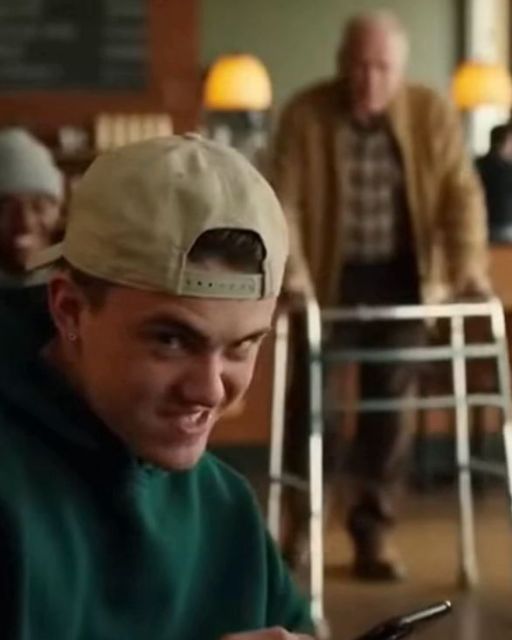
The kid with the backwards hat smirked at his phone. “Watch this,” he whispered. He walked over to the old man who was slowly making his way to a table and kicked his aluminum walker. It clattered across the floor.
The old man stumbled, catching himself on a chair. His hands were shaking, his face pale. He didn’t say a word. The teenagers roared with laughter.
I was about to stand up, my blood boiling, when the cafe door opened.
Four men walked in. They were all in their fifties, built solid, and moved with a terrifying quietness. They didn’t scan the room. They didn’t need to. Their eyes locked onto the old man.
One of them, a man with a jagged scar on his temple, walked over and picked up the walker. He gently placed it next to the old man, who was now sitting down. He put a hand on his shoulder.
Then, he turned to the kids. He didn’t raise his voice. He didn’t have to. The entire cafe had gone silent.
“You have five seconds to apologize to the Sergeant,” he said, his voice dangerously calm.
The kid with the hat scoffed. “Or what, old man?”
The man with the scar smiled, but it didn’t reach his eyes. “Or you’ll find out what happens when you disrespect the man who pulled three of us out of a burning helicopter.” He took a single step forward. “The fourth guy here? He was the pilot. And he just called…”
He let the sentence hang in the air, thick and heavy.
The kid, whose name I later learned was Kevin, crossed his arms. His bravado was paper-thin, but he was committed to it. “Called who? The cops? Go ahead. It was a prank.”
The man with the scar shook his head slowly. “Worse.”
The pilot, a man with silver hair and clear, sharp eyes, held up his phone. He hadn’t said a word until now. “I just called your father, Kevin.”
Kevin’s face went from smug to sheet-white in a heartbeat. His friends, who had been giggling and recording, slowly lowered their phones. The air in the cafe became tight, unbreathable.
“You don’t know my dad,” Kevin stammered, his voice cracking.
“I do,” the pilot said, his tone flat and even. “I flew him and his partners to a conference in Chicago last month. His name is Robert Davies. He runs Davies Construction.”
The pilot took a step closer, his gaze pinning the boy to the spot. “He’s a good man. I wonder what he’ll think of this video.”
One of Kevin’s friends frantically started deleting the footage from his phone. The man with the scar noticed and just raised an eyebrow.
“Too late,” he said softly. “My guy sent it to your father’s phone before he even answered.”
The silence that followed was profound. You could hear the hum of the refrigerator behind the counter, the quiet gulping of the teenagers.
The old man, the Sergeant, hadn’t moved. He just sat there, his frail hands resting on the table, watching everything unfold with tired, knowing eyes. He seemed sad, not angry.
Less than five minutes later, the cafe door flew open again. A man, broad-shouldered and wearing a work shirt with “Davies Construction” embroidered on it, stormed in. His face was a thundercloud of fury and shame.
He was looking for his son. His eyes found Kevin, and the boy physically shrank.
“Get up,” Robert Davies said, his voice a low growl. He didn’t look at anyone else yet. He just stared at his son with an expression of pure, unadulterated disappointment.
Kevin stood up, his head bowed. His friends looked like they wanted the floor to swallow them whole.
Mr. Davies then turned his attention to the five men at the table. He walked over, his anger deflating into deep mortification. He looked at the Sergeant, a man probably twenty years his senior, and his face softened with regret.
“Sir,” he said, his voice thick with emotion. “I am so, so sorry. I don’t know what to say. I raised him better than this. I thought I did.”
The Sergeant finally looked up at him. He gave a small, almost imperceptible nod.
Mr. Davies then faced the man with the scar. “And to you gentlemen. There is no excuse for his behavior. None.”
He reached for his wallet. “Whatever the damages, whatever you need. Let me pay for your meal. Let me do something.”
The man with the scar held up a hand. “Put your wallet away, Mr. Davies. This isn’t about money.”
He looked back at Kevin, who was still standing there, head down, feet shuffling. “This is about respect. Something your son and his friends clearly know nothing about.”
“What do you want me to do?” Mr. Davies asked, his voice desperate. “I’ll ground him for a year. I’ll take his phone, his car. Whatever you think is fair.”
For the first time, the old Sergeant spoke. His voice was raspy, thin with age, but it commanded the attention of the entire room.
“That won’t teach him anything,” he said quietly. “It will just make him resentful.”
Everyone turned to look at him. He was no longer just a victim; he was the judge.
“He doesn’t understand,” the Sergeant continued, his eyes on Kevin. “He sees an old man, and he sees a target. He doesn’t see a life.”
The man with the scar, whose name I learned was Marcus, looked at his old Sergeant with a deep, abiding respect. He waited for him to continue.
“You want to make this right?” the Sergeant asked, his gaze shifting from the father to the son.
Kevin finally looked up, his eyes red. He nodded mutely.
“An apology is just words,” the Sergeant said. “I want an education.”
He paused, taking a slow breath. “There’s a VFW post down on Elm Street. The roof leaks, the paint is peeling, and the garden out front is full of weeds because the men who go there are too old to tend to it themselves.”
He looked directly at Kevin and his two friends. “For the next four Saturdays, you three will be there. You will pull every weed. You will paint the fence. You will help Mr. Henderson fix that leaky gutter. You will listen to their stories. And you will do it without complaint.”
Kevin’s father, Robert, let out a breath he seemed to have been holding. “They’ll be there. I’ll make sure of it. I’ll be there with them.”
The Sergeant nodded. “Good.”
Then Marcus spoke again, turning back to Kevin. “You want to know why we call him Sergeant? Why we dropped everything to come here when he called and said he was just feeling a little down today?”
Kevin didn’t answer. He couldn’t.
“Thirty years ago, in a desert you’ve only seen in movies, our helicopter went down. It was on fire before it even hit the ground. I was trapped, my leg was broken. David, here,” he gestured to one of the other men, “was unconscious. The pilot, Sam, was trying to get the fire extinguisher, but his hands were burned.”
The cafe was so quiet you could have heard a pin drop on the carpet.
“This man,” Marcus said, his voice thick with a reverence that was almost holy, “was already out. He was safe. But he came back into the fire. He dragged me out by the collar. Then he went back in for David. The fuel tank blew just as he got clear, and the blast threw him twenty feet.”
He pointed to the old man’s slight limp, the way his hands shook. “He carries that day with him. Every single day. He came back for us. So we always come back for him. He’s not just an old man. He is our history. He is our hero.”
The weight of that story settled over the room. It was a physical thing. The cruel, stupid prank suddenly seemed sacrilegious.
Kevin’s face crumpled. Real tears streamed down his cheeks now, born not of fear, but of a sudden, crushing shame. He stepped forward.
“I’m sorry,” he whispered, looking the Sergeant in the eye. “I’m so sorry, sir.”
The Sergeant just held his gaze for a long moment. “We’ll see how sorry you are on Saturday, son. Eight a.m. Don’t be late.”
Mr. Davies herded his son and the other two boys out of the cafe, a firm hand on Kevin’s shoulder. The door closed behind them, and the tension finally broke.
The cafe owner, a middle-aged woman named Sarah who had been watching from behind the counter, came over with a fresh pot of coffee.
“This is on the house, gentlemen,” she said, her voice full of warmth. “For all of you.”
Marcus smiled, a real smile this time. “Thank you, ma’am.”
They sat there for the next hour, the five of them. They didn’t talk about the incident. They talked about their kids, about fishing trips, about a funny thing that happened at the hardware store. They were just men, friends, sharing a coffee. But they were bound by something stronger than blood. They were a family forged in fire.
I saw the Sergeant, whose name was Arthur, a few more times at the cafe after that. He was always quiet, always polite. He never brought up what happened.
Then, about a month later, something incredible happened.
I was at the cafe on a Saturday afternoon. The door opened and Sergeant Arthur walked in. But he wasn’t alone.
Kevin was with him.
The boy wasn’t smirking. His hat was on forwards. He held the door for Arthur, and then he gently took the walker and guided it to the table before helping the old man sit down.
“What can I get you, Sergeant?” Kevin asked, his voice respectful and quiet.
“Just a black coffee today, son,” Arthur said. “And get something for yourself. My treat.”
Kevin went to the counter and ordered. He paid with his own money, waving off Arthur’s cash. He brought the drinks back to the table, sat down, and didn’t look at his phone once.
They just sat there and talked. I saw Arthur laughing, a real, hearty laugh that made his eyes crinkle. I saw Kevin listening intently, leaning forward, completely absorbed in whatever story the old soldier was telling.
It turned out the four Saturdays had turned into five, then six. Kevin had kept showing up. He’d fixed the gutter, painted the fence, and now he spent most of his weekends at the post, just listening. He was learning their history. He was becoming a part of their story.
As I was leaving, I walked past their table. I heard Kevin say, “…so you really repaired the radio with a chewing gum wrapper and a paperclip?”
Arthur smiled, a twinkle in his eye. “Necessity, my boy. It’s the mother of all invention.”
That’s when I saw the real twist. It wasn’t that the pilot knew the kid’s dad. The real twist was that a moment of ugly, thoughtless cruelty had become a bridge between two generations. It had transformed a disrespectful kid into a compassionate young man.
The punishment hadn’t been a punishment at all. It was a gift.
It was a chance for a boy who saw only weakness to finally see the incredible strength hidden in the lines of an old man’s face.
We walk through life surrounded by quiet heroes, by people whose stories could fill books, but we’re often too busy or too distracted to notice. We see a slow-moving old man and feel impatience, not curiosity. We see frailty and forget the fire that forged it.
But every person carries a history. Every soul has a story of a burning helicopter in some form or another. The lesson isn’t just to not be cruel. It’s to be curious, to be kind, and to remember that the person you might dismiss is the very person who could teach you the most about courage, sacrifice, and what it truly means to be a hero.