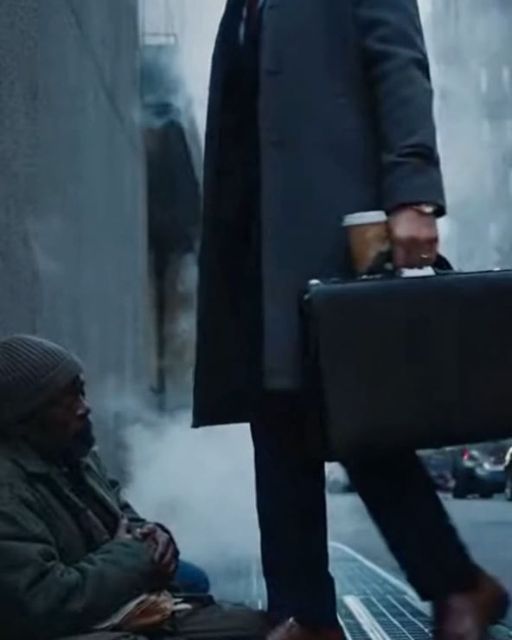
I watched my boss kick a sleeping man’s boots out of his way for six months.
Our office building shares an alley with the local VA hospital. Since January, a homeless veteran in a faded field jacket had been sleeping on the steam grate by our private entrance. Every single morning, our VP of Sales, Derek, would intentionally step right over him.
“Disgusting,” Derek would scoff loudly, making sure the old man heard. “These bums are ruining the property value. Get a job.”
The veteran never spoke back. He just kept his head down, clutching a stack of denied medical claim papers.
Yesterday morning, the grate was empty.
Derek laughed as we scanned our badges at the glass doors. “Finally,” he smirked. “Looks like the trash took itself out.”
At 10:00 AM, an emergency company-wide email went out. We had just been subjected to a hostile takeover by an anonymous private equity firm. The new majority owner was in the building, and the executive team was ordered to the main conference room immediately.
Derek practically sprinted to the elevator, fixing his expensive tie and practicing his corporate introduction. He was desperate to impress the new boss and save his six-figure job.
We filed into the boardroom. The large leather chair at the head of the table was turned around, facing the city windows.
Derek stepped forward, flashing a million-dollar smile. “Sir, it is an absolute honor to welcome you to the – ”
The chair slowly swiveled around.
My blood ran cold. Derek actually stumbled backward, his face turning the color of chalk.
The man sitting in the Chairman’s seat wasn’t wearing a tailored suit. He was wearing a faded field jacket.
He didn’t blink. He just stared dead at Derek, reached into his pocket, and slid a single piece of paper across the mahogany table that said…
“Disgusting.”
The word was written in sharp, deliberate letters. It was the only thing on the page.
A thick, suffocating silence fell over the boardroom. The air, once buzzing with nervous energy, was now as still as a tomb. You could have heard a pin drop on the plush carpet.
Derek’s million-dollar smile had completely vanished, replaced by a slack-jawed expression of pure, unadulterated shock. His face cycled through a series of pale colors, from chalk white to a sickly green.
The man in the chairman’s seat, the veteran from the alley, didn’t raise his voice. He didn’t have to. His presence filled the entire room.
“You said that word one hundred and twelve times,” the man said, his voice calm and steady, not hoarse and broken as I would have imagined. It was a voice that carried authority, a voice that had commanded before.
“One hundred and twelve times, you walked by and called me disgusting.”
Derek finally found his voice, though it came out as a strangled squeak. “I… I don’t understand. This is a joke, right? A prank?”
The man, whose name we would soon learn was Arthur Vance, simply raised an eyebrow. He gestured to a polished leather briefcase sitting on the floor beside him. A woman in a sharp lawyer’s suit, who had been standing silently in the corner, stepped forward and opened it.
She began placing neat stacks of documents on the table. Share certificates. Purchase agreements. Bank transfers in the eight-figure range. The paper trail was undeniable.
This was not a joke.
“You also told me to get a job,” Arthur continued, his eyes still locked on Derek. “I believe you said that ninety-seven times. Sound advice, as it turns out.”
The other executives in the room were frozen, their faces a mixture of confusion and dawning horror. They were connecting the dots, remembering the man in the alley they themselves had ignored every single day. They were realizing the magnitude of the situation.
I remembered one particularly cold morning in March. It had been sleeting, and the steam from the grate was the only thing keeping Arthur from freezing. Derek, in his cashmere overcoat, had a cup of coffee and a pastry bag.
He’d stopped right in front of Arthur, taken a large bite of his croissant, and then tossed the rest of the bag into a nearby trash can, just out of Arthur’s reach.
“Wouldn’t want you getting comfortable,” Derek had sneered before walking inside.
I felt sick to my stomach then, and I felt even sicker now. I hadn’t said anything. I had just walked past, my head down, ashamed of my boss and ashamed of my own silence.
Back in the boardroom, Derek was finally starting to process the reality of his nightmare. His survival instincts kicked in.
“Sir,” he began, his voice trembling as he took a step forward. “Mr… Mr. Vance. I am so profoundly sorry. I had no idea. It was… it was a terrible, terrible misunderstanding. I am not that person.”
Arthur leaned forward slightly, his gaze intensifying. “You’re not that person? Then who were you for the last six months, Derek? Who was that man who kicked my boots when I was asleep? Who was that man who told me I was a stain on the city?”
He paused, letting the questions hang in the air. “You weren’t talking to the Chairman of the Board then. You were talking to a man you thought had nothing. You thought I was worthless. That tells me exactly who you are.”
Derek’s face crumpled. He was desperate. “Please, sir. I have a family. A mortgage. I’ll do anything. I’ll apologize. I’ll make a donation.”
“A donation?” Arthur let out a short, dry laugh that had no humor in it. “You think money fixes this? You think you can write a check to absolve yourself of basic human decency?”
He then told us his story. Not all of it, but enough. He’d served two tours. He came home with scars, both visible and invisible. He’d started a small tech company in his garage, pouring his grief and focus into his work after losing his wife and daughter in a car accident.
He’d developed a revolutionary data compression algorithm. He sold the patent for a modest sum years ago but was smart enough to retain a 2.5% equity stake in the company that bought it. He never thought much of it.
Then, he hit rock bottom. The grief and the trauma caught up to him. He lost his house, his friends, everything. He ended up on the streets, fighting with the VA for the benefits he had earned, the benefits documented in the papers he clutched every day.
The grate outside our building was warm and close to the VA hospital. That’s why he chose it.
“And then, three weeks ago,” Arthur said, his voice quiet, “the small tech company that held my patent was acquired by a global conglomerate. My 2.5% stake became… significant.”
He didn’t need to say how significant. The papers on the table did that for him. He had become a multi-millionaire overnight.
“I could have checked into a hotel the next day,” he explained. “I could have bought a new suit, a new car. But I stayed. I stayed on that grate for three more weeks. I wanted to see. I just wanted to see what people were really like when they thought no one of importance was watching.”
His eyes scanned the room, moving past the other VPs, all of whom were now staring at the floor. Then, his eyes landed on me.
My heart hammered against my ribs.
“You,” he said, pointing a finger in my direction. “Your name is Simon, right?”
I could only nod, my throat suddenly dry.
“Last Tuesday. It was raining. You stopped.”
I remembered. It was a miserable day. I had an extra umbrella in my bag, a cheap one I’d picked up at a pharmacy. I hesitated for a moment, worried what Derek or others might say. But then I looked at Arthur, soaked to the bone, and I thought of my own grandfather, also a veteran, who had struggled so much when he returned home.
I had walked over and just placed the open umbrella beside him, leaning it against the wall to create a small shelter. I also left a hot cup of coffee from the cart on the corner. I didn’t say a word. I just did it and walked away quickly, feeling my cheeks flush with embarrassment.
I never thought he even saw who did it.
“You left a coffee,” Arthur said simply. “You didn’t want credit. You just did it. You thought no one was watching.”
He looked back at the lawyer. “Patricia, the paperwork for Mr. Peterson.”
She handed me a folder. I opened it with trembling hands. It was a promotion. To Vice President of Sales. Derek’s job. The salary was double what I was making.
“I need someone in that role who has a baseline of compassion,” Arthur stated plainly. “Business is about people. If you can’t see the person in front of you, you can’t lead.”
Then, he turned his attention back to the wreck of a man that was Derek.
“As for you, Derek,” Arthur said, his tone shifting. “You’re not fired.”
A flicker of hope sparked in Derek’s eyes. It was a pathetic sight.
“Firing you would be easy. You’d get a severance package and land on your feet somewhere else, having learned nothing. Your new job assignment starts tomorrow.”
Arthur slid another piece of paper across the table. It was a pamphlet for a local non-profit called “Stand Down,” an organization dedicated to helping homeless veterans get back on their feet.
“You are now our new full-time Corporate Liaison to the veteran community,” Arthur announced. “You will report to the director of that center every morning at 6:00 AM. You’ll be helping men and women like me fill out their VA paperwork. You’ll be serving them meals. You’ll be listening to their stories.”
He leaned in one last time. “Your salary will be exactly what the center’s director earns. Not a penny more. You’ll hold this position for one year. At the end of that year, the board of that non-profit – which now includes me – will decide if you’ve learned enough to be employable at this company again. In any capacity.”
Derek stared at the pamphlet as if it were a venomous snake. The color drained from his face again. It was a fate worse than being fired. It was a sentence of forced humility.
The meeting was over.
The months that followed were transformative. Arthur Vance, or Mr. Vance as we all called him, wasn’t a typical chairman. He implemented a company-wide “humanity first” policy. He started a program to actively recruit and train veterans. He established a charitable foundation funded by a percentage of the company’s profits.
The culture changed from a cutthroat sales environment to one of collaboration and respect. Productivity, surprisingly, went up.
I saw Derek a few times. The first time, he was clumsily serving soup at a Stand Down event, his expensive suit replaced with a stained apron. He wouldn’t make eye contact with me.
The last time I saw him was about ten months into his assignment. He was sitting with an elderly vet, patiently going through a mountain of paperwork, just like the stack Arthur used to hold. He was listening, really listening, to the man’s story. He looked older, tired, but his eyes had lost their arrogant gleam. They held a quiet understanding.
Maybe, just maybe, he was learning.
I thrived in my new role. I never forgot the lesson I learned that day in the boardroom. Every person you meet is fighting a battle you know nothing about. Their current circumstances are just a single chapter, not their whole story. The true measure of your character is how you treat someone who can do nothing for you.
Kindness is not a transaction; it’s a reflection of who you are. And sometimes, the person you dismiss as worthless might just be the one who ends up owning the entire building.