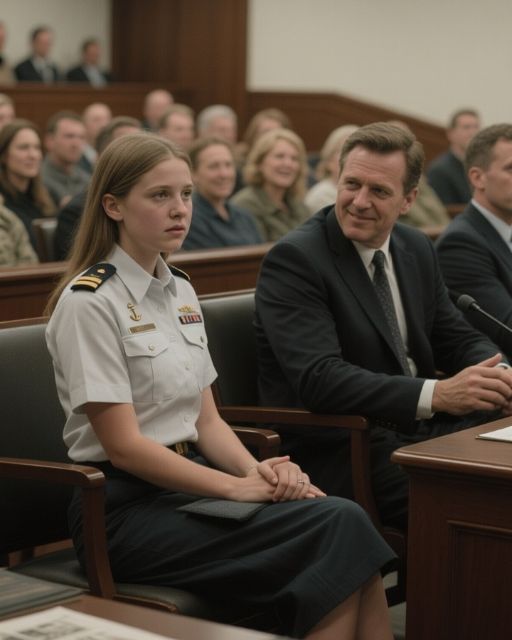
“There are NO female SEALs.”
The judge’s voice was a hammer. It cracked through the stuffy courtroom air and landed right on my twelve-year-old daughter.
The whole room was laughing at her.
And I couldn’t do a damn thing.
We were there because her mother, Anna, was a ghost. Months of silence. Another missed birthday, another sick-kid-in-the-ER-at-3AM run I had to do alone.
My lawyer had just finished painting a perfect picture of abandonment. It seemed so simple.
Then the judge looked at Lily. “Tell me about your mom, kid.”
My daughter walked to the stand, small but straight. Her thumb traced the tiny anchor on the necklace her mom had given her.
“She loves me,” Lily said, her voice clear. “She can’t always be here. It’s classified.”
A few snickers from the gallery.
The judge leaned forward, a predator smelling weakness. “Classified? And what does she do that’s so classified?”
Lily didn’t flinch. “She’s a Navy SEAL. One of the first.”
That’s when the dam broke. Laughter rolled through the benches. My own lawyer shot me a look of pity.
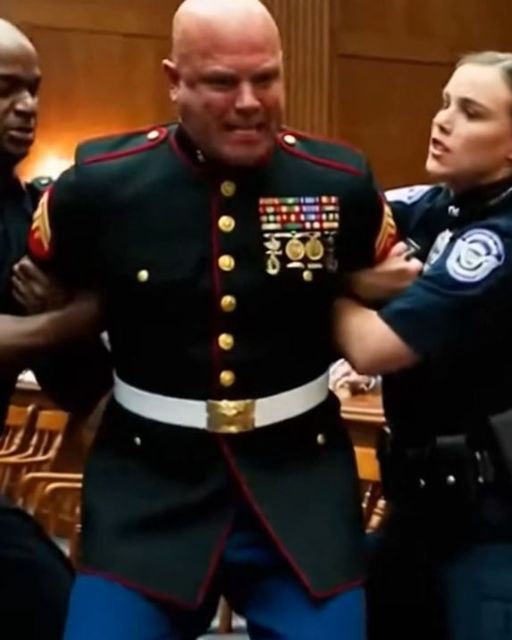
The judge’s face went crimson. He slammed his gavel down, the sound like a gunshot. “I served twenty-five years in the United States Navy!” he roared. “There is no such program. It does not exist.”
Lily’s eyes filled with tears, but her voice was a fierce whisper. “It does. I’ve seen her journal. The scars on her back.”
The opposing lawyer smiled a slick, cruel smile. “You saw things and ‘figured it out’? Honey, that’s just a story.”
My daughter’s face crumpled. “She’s a hero,” she choked out. “You have to believe me.”
The judge opened his mouth to deliver the final blow.
But he never got the chance.
A deep groan echoed from the back of the courtroom. The heavy oak doors swung inward.
Silence fell so fast it was like a physical blow. Every head turned.
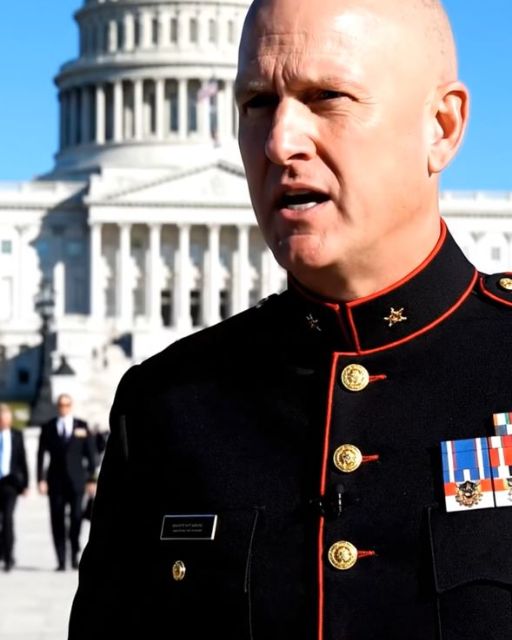
A figure stood in the doorway, framed by the light. Crisp service dress blues, a chest full of ribbons that told stories I couldn’t even imagine. Polished shoes clicked on the marble floor, each step an indictment.
It was her. It was Anna.
The judge’s jaw hung open. The smirks on the lawyers’ faces evaporated.
Anna’s eyes found Lily’s across the silent room. She gave a small, almost imperceptible nod.
Then she turned her gaze to the bench, her voice quiet but carrying the weight of an aircraft carrier.
“Judge Miller,” she said. “Apologies for my tardiness. I was unavoidably detained by a matter of national security.”
She paused, letting the words hang in the air.
“I trust my daughter’s testimony will suffice.”
And in that moment, watching the color drain from the judge’s face, I knew. I wasn’t just raising my daughter.
I was raising the daughter of a legend I had never truly met.
The silence in the courtroom stretched for an eternity. It was a heavy, weighted thing, full of unasked questions and shattered assumptions.
Judge Miller, the man who had been roaring moments before, now looked like a ghost. He stared at Anna, his eyes wide, tracing the lines of her uniform, the medals pinned to her chest.
He recognized something. I could see it in his face. It wasn’t just the uniform; it was the woman wearing it.
Anna didn’t move a muscle. She just stood there, a pillar of calm in the storm she had created. Her presence commanded the room in a way I had never seen before.
This wasn’t the Anna who left wet towels on the floor or hummed off-key while making pancakes. This was someone else entirely.
Finally, the judge cleared his throat, a dry, rasping sound. “Commander,” he said, his voice now a respectful murmur. The title hung in the air, confirming everything.
Anna’s lawyer, a woman who had looked utterly defeated just minutes ago, was now on her feet, a renewed fire in her eyes. But Anna held up a hand, a slight, dismissive gesture.
She didn’t need a lawyer to fight this battle. She was the weapon.
“My daughter,” Anna said, her voice still quiet but cutting through the tension, “is not a liar.”
She took a step forward, and then another. Her walk was measured, confident. Each click of her heels on the marble was a punctuation mark.
She stopped beside Lily’s witness stand. She didn’t look at me, or the judge, or the stunned lawyers.
She looked only at our daughter.
She reached out and gently touched the anchor on Lily’s necklace. “This was my mother’s,” she said, her voice softening for the first time. “She gave it to me for courage. Now it’s yours.”
Lily’s tears were flowing freely now, but they weren’t tears of sadness. They were tears of relief, of pure, unadulterated vindication.
“I told them, Mom,” Lily whispered. “I told them you were a hero.”
Anna’s expression didn’t change, but I saw a flicker in her eyes. It was a deep, powerful love, a love that had crossed oceans and deserts to be in this room.
“I know you did,” Anna replied. She turned back to the judge. “Your Honor, the details of my service are, as my daughter stated, classified. They will remain so.”
She pulled a single folded document from an inside pocket of her jacket. “However, my commanding officer has provided this letter. It confirms my active duty status and the non-traditional nature of my deployment cycles.”
Anna’s lawyer stepped forward to take the letter, walking it up to the bench like a holy relic.
Judge Miller took it with a slightly trembling hand. He read it, his eyes scanning the page once, then twice. The blood drained from his face.
He looked up from the paper, not at Anna, but at Lily. His expression was one of profound shame.
“This court,” he began, his voice thick with emotion, “was mistaken.”
He looked around the room, at the gawking faces, the whispering gallery. His gaze was sharp, accusatory. He was angry at them, but mostly, I think, at himself.
“The character of a twelve-year-old girl was called into question today,” he said, his voice rising again, but this time it wasn’t with rage. It was with a kind of righteous fury. “And the service of a decorated officer of the United States Navy was mocked.”
He let that sink in.
“This custody hearing is over. Case dismissed.” He slammed the gavel, but this time it wasn’t a sound of anger. It was a sound of finality. A full stop on the ignorance that had filled his courtroom.
As people began to shuffle out, whispering and staring, I finally walked over to them. To my daughter, and to the woman I had once called my wife.
I didn’t know what to say. “Thank you” felt too small. “I’m sorry” felt like a betrayal of all the lonely nights I had resented her.
Anna finally turned to me. Her eyes, which had been so hard and focused, were now tired. So incredibly tired.
“Can we go home, Mark?” she asked.
It was the first time she had used my name. It was the first time she had sounded like the woman I remembered.
The drive home was silent. Lily sat in the back, clutching her mother’s hand, her head resting on Anna’s shoulder. She was asleep before we even hit the highway.
I kept glancing over at Anna in the passenger seat. She stared out the window, her perfect military posture never wavering.
“You could have told me,” I said, breaking the silence. My voice sounded weak, childish.
She didn’t look at me. “No, I couldn’t.”
“Why not? I was your husband, Anna. We were a family.”
“And that’s exactly why I couldn’t tell you,” she said, her voice flat. “Plausible deniability. If you didn’t know anything, you couldn’t be a target. Neither could Lily.”
A target. The word hung in the air between us, cold and sharp.
“A target for what?” I asked, though I wasn’t sure I wanted to know.
She finally turned to look at me. The exhaustion in her eyes was a physical thing. It was etched into the fine lines around them.
“The things you see in movies, Mark? The bad guys? They’re real. And my job is to make sure they never get near people like you and Lily.”
I didn’t know what to say to that. All my anger, all my resentment over missed parent-teacher conferences and lonely holidays, it all just seemed so petty. So small.
When we got home, I carried a sleeping Lily inside and tucked her into bed. She was still holding her anchor necklace, a peaceful smile on her face.
I walked back out to the living room. Anna was standing by the fireplace, looking at the photos on the mantel. A picture of me and Lily at the beach. A school photo of Lily with a gap-toothed grin. A wedding photo of the two of us, young and clueless and smiling.
“I missed you,” I said, the words coming out before I could stop them.
She picked up our wedding photo, tracing my face with her finger. “I missed this,” she said softly. “Normal. Safe.”
She put the photo down and faced me. “I can’t stay long, Mark. A few days, maybe a week. To get things sorted.”
“Sorted?” I asked. “Anna, you just blew up a federal courtroom. I think things are a little beyond ‘sorted’.”
A rare, small smile touched her lips. “The brass is handling the judge. My appearance was… sanctioned. It was a last resort.”
“So where have you been?” I asked, the question that had been eating at me for six months. “We called every base, every contact we had. It was like you’d vanished.”
Her smile faded. The mask was back in place. “I can’t tell you that.”
“Damn it, Anna!” I snapped, my frustration boiling over. “After all of this, you still can’t give me anything?”
“My last mission,” she said, her voice dropping to a whisper. “It went wrong. We lost contact. For a long time, they didn’t know if I was… if I was coming back.”
The air left my lungs. The implications of her words crashed over me.
She wasn’t just on a mission. She was missing.
“They thought you were dead?” I whispered.
She gave a slow, deliberate nod. “For one hundred and twelve days.”
The world tilted on its axis. One hundred and twelve days of me thinking she had abandoned us, of me being angry and filing for custody. And all that time, she was in some unknown hell, fighting just to stay alive.
The guilt was a physical blow. It knocked the wind out of me.
“I’m so sorry,” I managed to choke out.
“Don’t be,” she said, her voice firm. “You were protecting Lily. That’s all that matters. You did exactly what you were supposed to do.”
The next few days were strange. It was like living with a ghost and a celebrity all at once. Anna helped Lily with her homework, her voice patient and calm. She made us dinner, a simple pasta dish that tasted like a memory.
But there were moments I’d catch her staring into space, her eyes a million miles away. Or she’d wake up from a nightmare, a strangled cry caught in her throat.
The scars Lily mentioned weren’t just on her back. They were all over her. Faded white lines on her arms, a puckered mark just below her collarbone. Each one a story I would never know.
One afternoon, the phone rang. It was Judge Miller.
“Mr. Davison,” he said, his voice formal but kind. “I owe you and your daughter an apology.”
“That’s not necessary, Your Honor,” I said. “We understand.”
“No, you don’t,” he replied. “I was a fool. An arrogant one. I let my pride and my own limited experience cloud my judgment. I almost hurt a very good family.”
He paused. “I did some checking. Through some old channels. Unofficial, you understand.”
“I understand,” I said, my heart starting to pound.
“The letter she brought… it didn’t tell the half of it. Mark, your ex-wife isn’t just a SEAL. She’s a part of a unit that technically doesn’t exist. The work they do… it saves lives. Thousands of them. Silently.”
I was quiet, absorbing his words.
“Her last assignment,” the judge continued, his voice low. “She wasn’t just ‘detained’. Her whole team was declared K.I.A. Killed in action. All of them.”
My blood ran cold. “But she’s here. She’s in my kitchen right now, making a sandwich for our daughter.”
“I know,” the judge said, a note of pure awe in his voice. “That’s the part no one can figure out. She was the sole survivor. She made it back on her own, through hostile territory, for weeks. The first official call she made wasn’t to her commanding officer. It was to her lawyer, to find out the time and location of your custody hearing.”
He was quiet for a moment. “She didn’t come back for a medal, Mark. She came back for your daughter.”
I hung up the phone, my hand shaking.
I walked into the kitchen. Anna was leaning against the counter, watching Lily draw at the table. There was a look of such profound, quiet love on her face that it hurt to see.
She looked up and saw me. She knew I knew. Maybe not the details, but the truth. The real truth.
“You weren’t coming home,” I said, my voice barely a whisper. “You were coming back from the dead.”
She didn’t deny it. She just nodded, her eyes welling up with tears she refused to let fall.
That night, after Lily was asleep, we sat on the porch. The silence between us was different now. It wasn’t angry or awkward. It was full of understanding.
“I kept a picture of her,” Anna said, looking up at the stars. “Tucked into my gear. Every time I thought I couldn’t take another step, I’d look at her face. I’d remember her smile.”
She finally looked at me. “I wasn’t fighting for a flag, Mark. Not really. I was fighting my way back to her.”
I reached out and took her hand. It felt small and fragile in mine, a stark contrast to the strength I knew she possessed.
“What happens now?” I asked.
“I have to go back,” she said. “Debriefing. Medical. They don’t just let you walk away from something like that.”
“And after?”
She shrugged. “I don’t know. My cover’s blown, at least locally. They might reassign me. A desk job, maybe. Training.”
“Could you do that?” I asked. “Could you live a normal life?”
“For her,” Anna said, squeezing my hand. “For Lily, I could learn.”
A week later, a black government car pulled up to the house. Anna came out, dressed not in her uniform, but in simple jeans and a t-shirt. She looked smaller, more vulnerable.
Lily ran to her, wrapping her arms around her mother’s waist and burying her face in her side.
“You’ll come back?” Lily asked, her voice muffled.
“I will always come back to you,” Anna promised, kissing the top of her head. “Always.”
She looked at me over Lily’s head. “Take care of her, Mark.”
“You know I will,” I said.
And then she was gone.
The weeks that followed were different. The ache of her absence was still there, but it was no longer laced with anger or confusion. It was replaced by a deep, humbling sense of pride.
Lily was different, too. She walked taller. The whispers at school had stopped. She was no longer the girl with the runaway mom. She was the daughter of a hero. Her secret was out, and she wore it like a badge of honor.
One evening, a package arrived. It was from Anna. Inside was a small, velvet box.
Lily opened it. Nestled inside was a medal. A Navy Cross. Pinned to it was a small, handwritten note.
“They give you these for being brave,” it read. “But I think you’re the bravest person I know. I love you. Mom.”
That medal now sits on Lily’s nightstand, right next to a picture of her mother. Not the decorated officer in dress blues, but a candid snapshot I took years ago. Anna is laughing, her head thrown back, the sun in her hair. She looks free.
I don’t know what the future holds for us. We’re not a normal family, and we probably never will be. Our life is a complicated tapestry of secrets and sacrifices.
But I’ve learned that heroism isn’t always loud. It’s not always about parades and public recognition. Sometimes, it’s a quiet promise whispered to a sleeping child. It’s the silent, relentless fight to come home.
Love, I’ve discovered, isn’t always about being present. Sometimes, the most powerful love is shown in the absence, in the shield someone builds around you with their own life. It’s knowing that somewhere out there, in the darkness, someone is fighting their way back to you. Always.