The sound was sharp and final.
A single, clean slap that cut through the humid air. Two thousand soldiers, locked in perfect formation, didn’t so much as flinch. But their eyes saw everything.
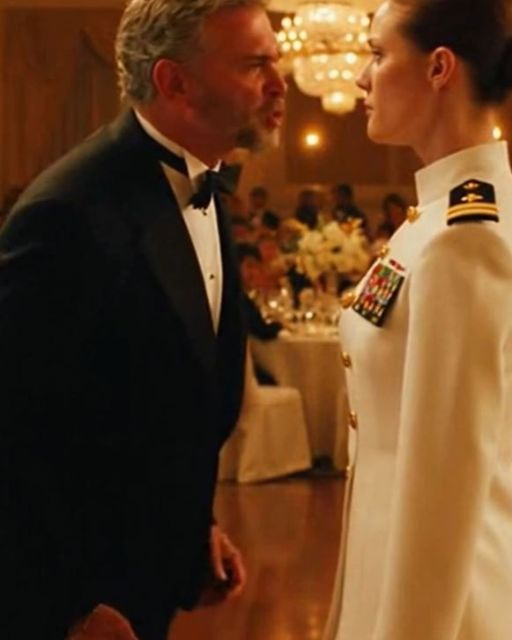
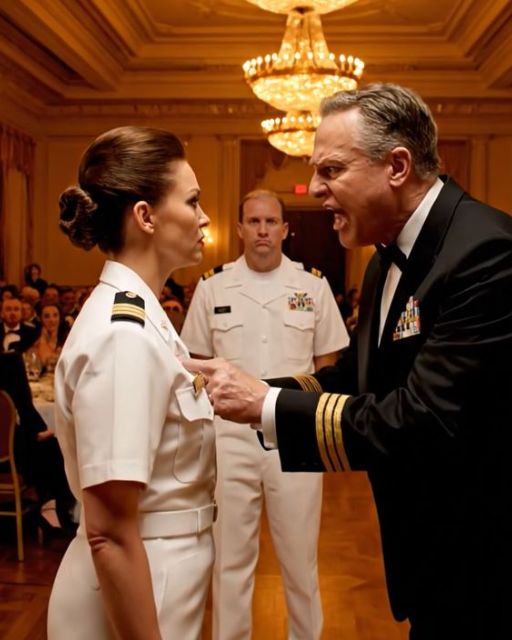
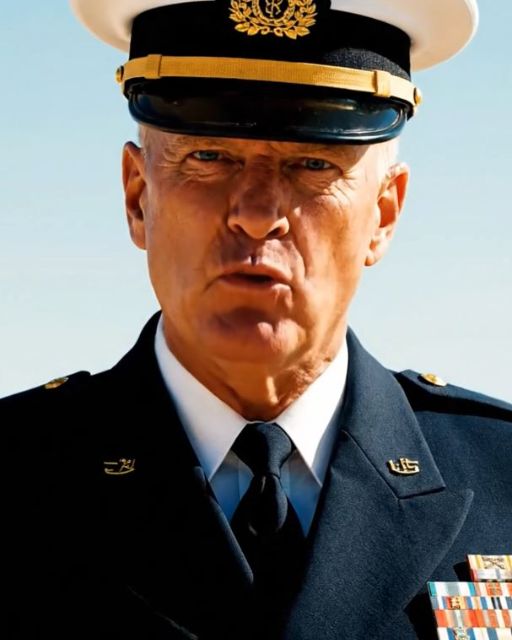
Admiral Marcus Thorne stood with his hand still in the air, his face a mask of crimson rage. The woman in front of him, dressed in nothing but worn-out fatigues and a t-shirt, didn’t even stumble.
“I gave you an order,” Thorne hissed, his voice a low growl that carried across the silent field. “You are a disgrace to this uniform. Get off my base.”
I could taste the salt and copper of my own blood.
My lip was split, but I didn’t wipe it. I just held his gaze.
“Security!” he finally roared, his composure cracking. “Remove this woman now!”
Two MPs broke from the line and charged forward, batons ready.
They were five feet away when they saw it.
They stopped. Not slowly, but instantly, as if they’d hit a wall. Their eyes dropped to the small, dark pin on my belt.
And just like that, their entire demeanor changed. They straightened their backs, snapped their heels together, and rendered a salute so sharp it could cut glass.
The Admiral’s jaw went slack. “What in God’s name are you doing? I gave you an order!”
I took a slow step toward him, closing the distance until I could smell the starch on his collar.
My hand went into my pocket.
The entire base held its breath.
I pulled out a photograph. It was creased and faded, the edges soft from wear. I held it inches from his face.
“My name isn’t ‘woman’,” I said, my voice dangerously quiet. “It’s Sergeant Major Rostova.”
His eyes flickered down to the photo. He saw a group of elite operators in a sun-scorched wasteland, their faces grim with exhaustion.
He squinted, his focus zeroing in on the team leader in the center. A young operator with tired eyes and the beginnings of a beard.
Then his gaze snapped back to my face.
He saw the faint scar above my left eyebrow. He saw the set of my jaw. He saw the exact same eyes staring back at him from the photograph he held.
The color drained from his face.
It was a cold, sudden plummet.
He hadn’t just struck a trespasser. He had just assaulted the only person who came back from the mission he swore to Congress had never happened.
The silence on that parade ground was a living thing.
It was heavier than the humid Georgia air, thicker than the tension you could cut with a knife.
Admiral Thorne’s mouth opened and closed, but no sound came out. His authority, so absolute just a moment ago, had evaporated like morning mist.
He looked at me, then at the two MPs standing at rigid attention, then out at the sea of faces watching him. Two thousand pairs of eyes, all seeing his perfect world shatter.
“What is the meaning of this?” he finally managed, his voice a pathetic rasp.
“This is the meaning, sir,” I said, my voice carrying with the unnatural clarity of a funeral bell. I kept the photo held between us.
“This is Staff Sergeant Ramirez. He was from El Paso. He had a wife and a little girl who will never know him.”
My finger tapped on a smiling face next to mine in the picture.
“This is Specialist Chen. He was twenty-two. He was the smartest man I ever knew, turned down a scholarship to MIT to serve.”
I moved my finger again.
“This is Sergeant ‘Big Mike’ Evans. He carried our communications pack and half of my gear after I took a round to the leg. He saved my life.”
My voice started to shake, just a little. Not from fear, but from the weight of the names.
“And this is Corporal Davies. The kid. He was nineteen. All he talked about was going home to fix up his dad’s old Mustang.”
I finally lowered the photo. “They were my team. They were your soldiers.”
“Operation Nightshade was a success,” he stammered, falling back on the official lie. “There were no American casualties.”
A bitter laugh escaped my lips.
“It wasn’t called Nightshade. It was Operation Sand Viper. And it wasn’t a success. It was a slaughter.”
I took another step closer, invading his space, forcing him to look at me. To truly see me.
“You sent us in on bad intelligence. You sent five of us into a hornet’s nest that was supposed to be an empty warehouse.”
His eyes darted around, looking for an escape, an ally, anyone. He found no one.
“We were compromised before our boots hit the ground,” I continued, my voice dropping lower. “They were waiting for us, Admiral. An army of them.”
The memory was so vivid, so raw. The smell of dust and cordite. The screams.
“We fought for eighteen hours. Eighteen hours, sir. With no support. No extraction. We called for help until our radios went dead.”
I could see the beads of sweat on his forehead.
“When it was over, I was the only one left breathing. I buried them myself. With my bare hands.”
I held up my hands, showing the faint, silvery scars on my palms.
“Then I walked for three days across the desert to get to an extraction point that you never intended for us to reach.”
Thorne finally found his voice, a desperate, blustering roar. “This is classified information! You are in violation of…”
“Violation?” I cut him off, my voice rising for the first time. “You want to talk about violations? You left my men to rot in unmarked graves and then you stood in front of a congressional committee and you lied.”
The words hung in the air. The final, unforgivable sin.
“You erased them,” I said, my voice breaking with a grief I’d held inside for two long years. “You erased their sacrifice. You erased their names.”
From the side, a new figure emerged. It was the base commander, Colonel Peters. A man I knew by reputation only. He was weathered, decent, and by the look on his face, utterly horrified.
“Admiral,” Peters said, his voice firm but respectful. “Perhaps we should take this to my office.”
Thorne latched onto the lifeline. “Yes, Colonel. An excellent suggestion. This is a private security matter.”
“No,” I said, my voice like steel. “This is not a private matter. This is a matter of honor.”
I turned my attention from Thorne to the two thousand soldiers still standing in perfect, silent formation.
“These men and women deserve to know what a star on the shoulder is really worth,” I said, loud enough for the front ranks to hear. “They deserve to know that their service won’t be wiped away to protect a career.”
Thorne’s face turned a shade of purple I’d never seen before. He had lost. He knew it. The entire base knew it.
“I did what I had to do!” he finally screamed, all pretense of command gone. He was just a man, cornered and afraid. “The intelligence was compromised! Acknowledging the mission would have exposed a critical asset!”
“There was no critical asset!” I shot back. “There was just bad information! And you didn’t want the failure attached to your name before a promotion board!”
That was the truth of it. The simple, ugly, selfish truth. Four good men had died for one man’s ambition.
Colonel Peters stepped between us. He looked at Thorne with a mixture of pity and contempt. Then he looked at me. His eyes were clear and steady.
“Sergeant Major,” he said, his voice full of a quiet authority that Thorne had never possessed. “What is it you want?”
It was the question I had been waiting for. The reason I had walked onto this base in worn-out fatigues, a ghost from a forgotten war.
I didn’t want revenge. Revenge wouldn’t bring my men back.
I wanted restoration.
“I want their names read,” I said, my voice thick with emotion. “I want their sacrifice acknowledged. Right here. Right now.”
Colonel Peters held my gaze for a long moment. He saw the truth in my eyes. He saw the exhaustion and the pain and the unyielding loyalty to the men I had lost.
He nodded slowly. “Admiral Thorne,” he said, turning to the now-shaking man. “You are hereby relieved of your duties on this base. Confine yourself to your quarters. The Pentagon will be in touch.”
It was a quiet, brutal end to a celebrated career.
Thorne didn’t protest. He just deflated, the rage and bluster draining out of him, leaving a hollowed-out old man. The two MPs, without being asked, moved to escort him away. They didn’t touch him. They just flanked him, a silent, damning guard of dishonor.
As he was led away, a small, black car pulled up near the stands. A man in a simple grey suit got out. He didn’t look at me, but at the retreating form of Admiral Thorne. He exchanged a few quiet words with one of the MPs.
I recognized him. He was from the Inspector General’s office. My anonymous tip, sent weeks ago, had finally borne fruit. They were just waiting for the right moment. I had provided it.
But there was another twist, a secret I had held even closer than the photograph. A reason for Thorne’s panic that went deeper than just a failed mission.
As the Admiral passed me, his eyes met mine one last time. They were filled with a strange mix of hatred and a plea for understanding.
“You don’t know what you’ve done,” he whispered, a desperate, broken sound. “It was my son.”
The words hit me harder than his slap.
“My son,” he repeated. “He was the intelligence analyst. It was his first field report. He made a mistake. A terrible mistake. I was… I was protecting him.”
Suddenly, it all made sense. The ferocity of the cover-up. The absolute denial. It wasn’t just about his career. It was about his child. He had sacrificed my entire family to save his.
The knowledge didn’t bring me satisfaction. It just brought a profound, aching sadness. He was a monster, yes, but he was a father, too. His lie had destroyed him long before I ever showed up.
I watched him go, a man who had lost his honor, his career, and now, undoubtedly, his son’s future as well. The truth had a way of consuming everything in its path.
Colonel Peters turned back to me. The field was still silent. The soldiers hadn’t moved.
“Sergeant Major,” he said, his voice gentle. “Give me the names.”
I took a deep, shuddering breath. I looked at the flag, whipping in the wind.
“Staff Sergeant Hector Ramirez,” I began.
Colonel Peters walked to the podium. He took the microphone. His voice, amplified by the speakers, boomed across the parade ground, clear and strong.
“Attention!” he commanded. The sound of two thousand pairs of boots snapping together was thunderous.
“Today, we honor soldiers who were lost to us. Men whose service was not recorded. Today, we correct that.”
He looked at me. I gave a slight nod.
“Staff Sergeant Hector Ramirez,” the Colonel’s voice rang out, echoing off the barracks.
A single bell began to toll from the base chapel.
“Specialist David Chen.”
The bell tolled again.
“Sergeant Michael Evans.”
Another toll, mournful and deep.
“Corporal Samuel Davies.”
The final toll hung in the air, a sound of profound respect and sorrow.
The Colonel ordered the base flag lowered to half-mast. As the flag made its slow, solemn descent, I felt the two-year-old weight on my shoulders finally begin to lift.
I didn’t stay for the rest of the ceremony. My mission was complete.
I walked away from the parade ground, just another figure in a crowd of uniforms. No one stopped me. No one questioned me.
I reached the main gate and looked back one last time. The flag was at half-mast against the blue sky. The names of my men were no longer a secret whispered in the dark. They were a part of history.
Justice isn’t always about punishment. Sometimes, it’s about remembrance.
Admiral Thorne’s lie was a heavy stone he chose to carry, and in the end, it drowned him. He tried to bury the truth, but the truth is a seed. It will always, always find its way to the light.
My men were gone. Nothing would ever change that. But on that day, in front of two thousand witnesses, they were finally brought home. Their honor was restored. And for a soldier, honor is the only thing we truly carry with us in the end.