It Was Supposed to Be Just Another Quiet Night at a Small-Town Police Station – Until a Barefoot Little Girl Walked In Holding a Crumpled Paper Bag and Softly Said Something That Left Everyone Frozen…
THE DOOR THAT OPENED AT 9:43 P.M.
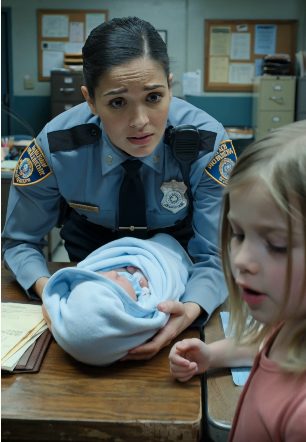
A barefoot little girl walking into a police station was not something Sergeant Michael Carter expected to see in twelve years on the force. Maple Ridge, Ohio, was the kind of town where nights passed quietly and predictably, where officers worried more about teenagers setting off fireworks than serious emergencies. By late evening, the station usually settled into a slow routine filled with paperwork, lukewarm coffee, and conversations designed mostly to stay awake.
That Tuesday night felt exactly like every other one before it.
Rain tapped softly against the windows, turning the streetlights outside into blurred circles of gold. Michael sat behind the front desk reviewing incident reports while Officer Jessica Parker joked with dispatch about whose turn it was to bring donuts the next morning. A television mounted in the corner played the local news with the sound muted, and nobody paid attention to it.
“Slowest shift of the month,” Jessica said, stretching her arms over her head.
“Don’t say that,” Michael replied without looking up. “You’ll jinx us.”
The building hummed with familiar sounds – printers clicking, radios crackling quietly, and the old air-conditioning unit rattling the way it always had.
Nothing about the night suggested that anything unusual was about to happen.
Then the front door opened.
The soft electronic chime echoed through the station.
Michael glanced up casually – and immediately sat straighter in his chair.
A little girl stood just inside the doorway.
She didn’t walk forward. She didn’t speak.
She simply stood there, framed by darkness and rain behind her, as though taking another step required courage she wasn’t know she still had.
She was barefoot.
Not the carefree barefoot of a child playing outside in summer – but the painful kind.
Mud covered her feet. Small cuts marked her heels. One toe was still bleeding slightly, leaving tiny spots on the tile floor.
An oversized denim jacket hung awkwardly from her small shoulders, the sleeves swallowing most of her hands. Damp brown curls clung to her cheeks, and dirt streaked across her pale face.
But what stopped Michael cold were her eyes.
They held a kind of exhaustion no child should ever carry – the look of someone who had already faced far too much alone.
He stood slowly, instinctively lowering his voice.
“Hey there,” he said gently. “You’re okay. Come on in.”
The girl held something tightly against her chest – a wrinkled brown paper bag folded carefully at the top as though it contained something fragile.
Officer Jessica noticed her and froze.
“Sweetheart,” Jessica said softly, crouching slightly. “Where’s your family?”
The girl swallowed hard.
Her breathing sounded uneven, as though she had been running for a very long time.
She took one cautious step forward.
The paper bag crinkled loudly.
Michael noticed dark stains spreading across the bottom.
His pulse immediately quickened.
“What’s your name?” he asked.
The girl hesitated before answering.
“Emma.”
Her voice trembled so softly he almost didn’t hear it.
Then she whispered something that instantly changed the atmosphere inside the station.
“He won’t wake up.”
Michael felt a heavy weight settle in his chest.
“Who won’t wake up?” he asked gently, though urgency was already creeping into his voice.
“My baby brother.”
She extended the paper bag toward him with shaking hands.
For a moment, Michael’s mind refused to process what he was seeing.
The bag seemed impossibly small compared to the fear in her voice.
He accepted it carefully.
The coldness inside shocked him immediately.
Michael opened the bag.
Inside, wrapped in thin kitchen towels, lay a newborn baby.
Still.
Silent.
Far too quiet.
Jessica gasped behind him.
Michael reacted instantly.
“Dispatch!” he shouted. “Medical emergency! Infant in distress! Get an ambulance here now!”
The peaceful station exploded into motion.
Radios crackled to life.
Chairs scraped across the floor.
Officers rushed into action.
Urgency filled every corner of the building.
But Emma grabbed Michael’s sleeve tightly.
“I walked as fast as I could,” she whispered, panic finally breaking through her voice. “I tried to keep him warm.”
Michael immediately knelt beside her.
“You did exactly the right thing,” he said firmly. “You brought him here. That’s what matters.”
Outside, the sound of approaching sirens cut through the rain.
And only then did Emma finally begin to cry…
The Baby in the Towels
Jessica wrapped Emma in her own police jacket before anyone found a blanket.
The girl fought it at first.
“No,” she said, pulling away. “He gets warm first.”
“He is,” Jessica promised. “Look at me, honey. He is.”
Michael had the baby on the front counter now, the brown paper bag flattened beneath him like some terrible little mat. The towels were damp. One had yellow daisies printed along the edge. The other looked like it had come from a kitchen drawer and been washed a hundred times.
The baby was bluish around the lips.
Michael put two fingers against the tiny neck, then the chest. Nothing at first. His own fingers felt too large, too rough. He had helped pull drunk men out of ditches, kicked doors, wrestled a man with a knife behind Wally’s Auto Parts.
This was different.
“Come on,” he said under his breath. “Come on, buddy.”
Then he felt it.
So faint he almost missed it.
A flutter.
“I’ve got a pulse,” Michael said.
Jessica’s hand flew to her mouth.
Dispatcher Linda Cobb, who had worked that desk since Michael was in high school, turned pale but kept talking into the radio. “Infant has a pulse. Repeat, infant has a pulse. Possible hypothermia. Station lobby.”
Michael began clearing the airway the way he’d been trained. Small movements. Careful. The baby made no sound.
That was the worst of it.
No crying.
Emma stood three feet away, wrapped in Jessica’s jacket, watching with eyes too wide for her face.
“His name is Benny,” she said.
Michael looked up for half a second.
“Benny?”
Emma nodded. “Mom said Ben, but I call him Benny because he’s tiny.”
“Benny,” Michael said, looking back down. “Okay. Stay with me, Benny.”
The ambulance doors slammed outside.
Two EMTs rushed in through the rain, boots squeaking across the tile. Ron Blevins came first, a big man with a gray mustache and a red medical bag in one hand. Behind him was Tasha Reed, already pulling gloves on with her teeth.
“What do we have?”
“Newborn,” Michael said. “Cold exposure. Weak pulse. Breathing shallow or not at all.”
Ron moved in fast. “Move the towels. Tasha, warmer pack. Now.”
Emma made a sound then, not quite a cry.
Jessica crouched in front of her to block part of the view. “Hey. Look at me. Look right here.”
“But he doesn’t like strangers.”
“I know,” Jessica said. “But these strangers are very good at babies.”
Emma blinked at that, confused enough to stop shaking for two seconds.
Ron placed an oxygen mask near the baby’s face, too large for him but angled just right. Tasha worked with the small bag, her fingers steady. Michael stepped back because his part was over and somehow that felt worse.
He hated waiting.
Waiting was useless.
“Pulse is there,” Ron said. “Weak. Body temp low. We need to roll.”
The baby’s chest twitched.
Then came a sound.
Small.
Broken.
But there.
A thin gasp.
Emma heard it and surged forward, but Jessica held her gently.
“He made a noise,” Emma said.
“He did,” Jessica told her.
“He’s not dead?”
Nobody liked the word.
Michael answered anyway.
“No. He’s not dead.”
Emma pressed both fists against her mouth and sobbed hard, bending at the middle like someone had knocked the air out of her.
The House With the Deer Mailbox
They put Emma in the back of the ambulance with Jessica beside her.
At first, Michael planned to go too. Then Emma grabbed his hand so tightly her dirty nails dug into his skin.
“Mommy,” she said. “She’s still there.”
Everything stopped again.
Michael leaned closer. “Where, Emma?”
“At home.”
“Is she hurt?”
Emma nodded once.
“Is she awake?”
The girl looked toward the ambulance doors, where Ron was lifting the baby inside. Rain dotted her cheeks and mixed with the dirt there.
“She told me to run.”
Michael felt the station shift around him. Not in sound. In shape.
“Where do you live?”
Emma squeezed his hand harder. “I’m not supposed to tell strangers.”
Jessica’s face changed.
Michael kept his voice even. “That’s a good rule. Your mom taught you right. But police officers can help when someone’s hurt.”
Emma stared at his badge as if checking it against something in her head.
“There’s a deer mailbox,” she whispered. “It’s white. The deer has one broken horn. There’s a red truck, but it doesn’t work. And a big tree that got hit by lightning.”
Michael turned. “Linda, county road properties with deer mailboxes, broken horn if anybody knows. Call patrol. Now.”
Linda was already moving.
Emma shook her head. “No. It’s past the church. Not the big church. The little one with the bell that doesn’t ring right.”
Michael knew it.
Everyone in Maple Ridge knew it.
St. Bartholomew’s sat on Palmer Road, two and a half miles from the station if you cut past the old feed mill. Farther if you stayed on pavement. Emma had come through mud, rain, and dark carrying a newborn in a paper bag.
Barefoot.
Michael’s jaw tightened.
“Palmer Road,” he said. “House near St. Bart’s. Deer mailbox. Jessica, stay with her. I’m going.”
Emma looked panicked. “No, you have to make Benny wake up.”
“Ron and Tasha are doing that,” Michael said. “I’m going to get your mom.”
The girl’s face twisted. “Don’t let Darren find her first.”
That name landed badly.
“Who’s Darren?” Michael asked.
Emma looked down.
The ambulance lights washed red across the lobby windows.
“My mom’s boyfriend,” she said. “He gets mad at crying.”
Michael didn’t ask the next question in front of her.
He didn’t need to.
He ran.
Palmer Road
Officer Greg Haskins drove the cruiser because Michael’s hands were not right.
He would never admit that later. Not to Greg. Not to Jessica. Not to himself if he could help it. But when he tried to put the key in the ignition, he missed once, then again. Greg took the keys out of his hand without a word.
Rain came down harder as they headed east.
Palmer Road was mostly fields, old homes set too far back from the street, drainage ditches deep enough to swallow a tire. The cruiser’s headlights caught fence posts, weeds, a plastic grocery bag snagged on wire and snapping in the wind.
Michael radioed details as Linda confirmed them.
“Property registered to Tracy Willard,” Linda said. “Thirty-one. One prior domestic call eighteen months ago. No charges filed. No active protection order.”
Greg glanced over.
Michael said nothing.
They passed St. Bartholomew’s at 9:58 p.m. The little church sat dark except for one security light above the side door. Its bell tower leaned slightly, the way it always had. Michael remembered climbing that fence at sixteen with Danny Burke and getting chewed out by Father Paul so badly he went to confession just to make the man stop talking.
Then Greg slowed.
“There.”
A white mailbox.
A painted deer on top.
One antler broken clean off.
The driveway was rutted gravel and mud. At the end sat a small yellow house with dark windows and a sagging porch. A red truck rested near the side yard, hood up, dead as a brick. No other vehicle.
Michael and Greg got out with flashlights drawn.
The front door stood open about four inches.
Rain blew onto the porch floor.
“Police,” Michael called. “Maple Ridge Police Department.”
No answer.
They stepped inside.
The house smelled of wet clothes, old smoke, and something sharp beneath it. Medicine maybe. Blood.
A lamp lay knocked over in the living room, shade crushed. A cartoon played on the television with the volume turned low. A purple backpack sat by the couch. Child’s size.
Emma’s.
Michael’s flashlight moved across the room.
On the coffee table sat a pair of small pink sneakers.
Dry.
Placed neatly side by side.
That detail made him angrier than the broken lamp.
Greg checked the kitchen. “Clear.”
Michael moved down the hall. “Tracy Willard? Police. Can you hear me?”
A sound came from behind a closed bedroom door.
Not words.
A scrape.
Michael tried the knob.
Locked.
“Tracy?”
Another scrape.
Greg stepped beside him. “Move.”
One kick broke the cheap frame.
The door slammed inward.
Tracy Willard lay on the floor beside the bed, one hand tied to the metal bedframe with a phone charging cord. Her hair stuck to her face. Her nightshirt was soaked through at the front. A towel was pressed between her legs, dark and heavy.
Her eyes were open.
Barely.
Michael dropped to his knees. “Tracy. I’m Sergeant Carter. Your daughter made it to the station.”
Her lips moved.
He leaned close.
“Baby?”
“He’s alive,” Michael said. “He’s with medics.”
She closed her eyes.
“Stay with me,” he said. “Tracy, stay awake. Greg, get EMS here now.”
Greg was already on the radio.
Tracy’s hand twitched against the cord.
Michael pulled his pocketknife and cut it loose. Her wrist was raw.
“Where’s Darren?” he asked.
Her eyes moved toward the closet.
Michael turned fast, hand on his weapon.
Greg crossed the room and opened it.
Empty.
On the closet floor sat a cell phone with a cracked screen. Beside it, a pair of men’s boots.
Mud still fresh on the soles.
What Emma Had Done
The second ambulance reached the house at 10:07 p.m.
By then, Michael had found the back door wide open.
Darren Pike had run into the fields behind the property without shoes.
That was the part that made Greg mutter a curse under his breath. The boots in the closet. The mud. The bare feet.
“He took hers,” Greg said.
Michael looked at him.
“Emma’s shoes,” Greg said. “He took hers so she couldn’t run.”
Michael didn’t answer.
Outside, the rain beat hard against the tin roof of a small shed. Two county deputies arrived with spotlights and a dog from Ashland. Flashlights swept over wet grass and fence lines.
Inside, Tracy kept trying to talk.
The paramedics told her not to.
She did it anyway.
“She took him?” Tracy rasped.
Michael crouched beside the stretcher as they lifted her. “Emma brought him to us.”
Tracy’s face crumpled in a way he had no clean place to put.
“I told her to hide,” she whispered. “Not run. I said hide.”
“She made a good call.”
“She’s six.”
Michael looked away for half a second.
On the nightstand, beside a chipped mug and an empty bottle of prenatal vitamins, sat a folded school worksheet. Emma Willard printed across the top in big uneven letters. Underneath, she had colored a drawing of a family: a woman, a girl, and a small blue bundle.
No Darren.
The first turn in the case came from Emma herself.
At the hospital, while doctors worked on Benny and nurses cleaned her feet, Jessica asked if Darren had hurt her.
Emma shook her head.
“Did he hurt your mom?”
Emma stared at the blanket over her knees.
“He said Benny wasn’t real family.”
Jessica wrote that down, though her hand slowed.
“What did he mean?”
“Mom said he was just mad.”
“Did Darren hurt the baby?”
Emma’s chin started to wobble.
“He put him in the sink.”
Jessica’s pen stopped.
“What sink, honey?”
“The kitchen sink. He said babies cry because people pick them up too much. Mommy yelled. He hit her. Then she had red on her legs. I got Benny out when Darren went to get beer.”
Jessica swallowed.
Emma kept talking because once the words started, she seemed afraid to stop.
“I put him in towels. Mommy said take the phone. But the phone was cracked. Then she said go to the police. She said follow the road lights and don’t stop for anybody.”
“And the bag?”
Emma looked ashamed.
“I couldn’t hold him good. He kept slipping. The bread bag was too little. So I used the big bag from the potatoes.”
Jessica had to put her pen down.
A nurse named Marcy stood by the door, pretending to check the chart. Her eyes were red.
Emma picked at the edge of the hospital blanket.
“I forgot his hat,” she said.
Jessica moved closer. “You remembered him.”
Emma didn’t seem to understand why Jessica couldn’t talk after that.
Darren Comes Back
They found Darren Pike at 11:31 p.m.
Not in the fields.
Not hiding in a barn.
He walked into the hospital emergency entrance wearing socks black with mud and a gray hoodie pulled up around his face. He told the front desk he was there for his girlfriend and “their baby.”
Michael saw him first from the hallway.
Darren was shorter than Michael expected. Thin. Wet hair stuck to his forehead. His left hand had dried blood across the knuckles.
He looked nervous, but not scared enough.
That bothered Michael.
“Darren Pike?” Michael asked.
The man turned.
His eyes flicked to Michael’s uniform, then to the exit behind him.
“Yeah. What’s going on? Tracy okay?”
Michael stepped closer. “Where have you been tonight?”
“Home. Then I went looking for help.”
“In your socks?”
Darren glanced down like he’d forgotten feet existed.
“I lost my shoes.”
Michael nodded once. “Turn around.”
“For what?”
“Turn around.”
Darren smiled then. Not big. Just enough.
“She tell you I did something? Tracy gets confused. She had the baby at home and freaked out. I was trying to keep everybody calm.”
Michael took one more step.
Darren lowered his voice. “That little girl lies too. You know kids.”
Michael did not remember moving his hand to the cuffs. He only remembered the click.
Darren jerked. “Hey. Hey, what the hell?”
Officer Haskins came in from the side and took his other arm.
“You’re being detained,” Michael said.
“For walking into a hospital?”
“For starters.”
Darren twisted enough that two nurses backed away. “You don’t know anything.”
Michael leaned in, close enough to smell beer under rainwater.
“A six-year-old carried a newborn two miles in a paper bag because she thought you’d let him die.”
Darren’s face changed.
Just for one second.
Then it hardened again.
“I want a lawyer.”
“Good,” Michael said. “You’ll need one.”
As they walked him out, Emma saw him from the pediatric room.
Jessica moved fast, stepping between them.
But Emma had already gone stiff.
Darren looked over Jessica’s shoulder and smiled at the little girl.
It was tiny. Mean. A secret kind of smile.
Emma reached for the plastic cup on the bedside table and threw it.
It bounced off the doorframe, water splashing across the floor.
“Don’t look at Benny,” she screamed.
Every adult in that hallway froze for half a beat.
Then Marcy the nurse picked up the cup, set it back on the table, and shut the door in Darren Pike’s face.
Morning in Maple Ridge
Benny’s temperature came up just after midnight.
At 12:18 a.m., he cried.
A real cry this time.
Thin, angry, alive.
Ron Blevins came out of the treatment room, rubbed both hands over his face, and said, “He’s mad now. That’s good.”
Jessica laughed once, the sound cracking in the middle.
Emma was asleep by then, curled sideways in a hospital chair, one bandaged foot sticking out from under the blanket. She had refused a bed until someone promised her Benny was in the same building. Then she refused again until Jessica sat beside her.
So Jessica sat.
Michael went back to the station at 2:40 a.m. to file the first reports. His uniform had mud on both knees. There was blood on one cuff. In the lobby, the brown paper bag still sat in an evidence tray, damp and misshapen.
He stared at it longer than he should have.
Linda came out from dispatch with fresh coffee.
Neither of them said much.
By sunrise, Maple Ridge knew something had happened, though not the details. A few people saw the cruisers on Palmer Road. Someone posted about ambulances at the hospital. By 8:00 a.m., Joyce at the diner had already sent over egg sandwiches because that was how the town handled fear: feed whoever looked closest to it.
At 9:15, Michael returned to the hospital.
Tracy Willard had survived surgery.
She was pale, exhausted, and furious with herself in the way victims often were, blaming the one person in the room who had been bleeding. Michael had seen it before. It never got easier.
Emma was awake when he entered, sitting in bed now with a tray of untouched pancakes. Her hair had been washed. Without the mud, she looked even smaller.
Jessica sat beside her, peeling an orange badly.
“You’re making it all hairy,” Emma told her.
“I’m a police officer, not an orange expert.”
Emma looked at Michael.
“Did you find my shoes?”
He had not expected that.
“They’re at your house,” he said. “We’ll get them.”
“They’re my fast shoes.”
“I figured.”
She nodded, satisfied with that answer.
From the room next door, Benny cried again.
Emma’s whole face changed.
“Can I see him?”
Jessica looked toward the nurse.
Marcy appeared in the doorway as if she had been listening the entire time. “Two minutes. And you wash your hands like you’re scrubbing mud off a dog.”
Emma slid off the bed. She winced when her feet touched the floor.
Michael reached out, but she shook her head.
“I can walk.”
She did.
Slow, bandaged, stubborn.
In the nursery room, Benny lay inside a warmer with a little striped hat on his head. Tubes and wires ran around him, but his color had changed. He was pink now. Unhappy. Busy being alive.
Emma stood on a step stool to see him.
She placed one hand against the clear side.
“Hi, Benny,” she whispered. “I’m sorry about the potato bag.”
The nurse turned her face away.
Michael looked down at his boots.
Jessica wiped her nose with the back of her hand and pretended she hadn’t.
Benny opened his mouth and cried at the ceiling.
Emma smiled.
“He knows me,” she said.
The Paper Bag
The case went to county court weeks later.
Darren Pike pled not guilty at first. Then the evidence piled up in ugly, ordinary ways: the cord around Tracy’s wrist, the neighbor who heard shouting, the phone he smashed, the boots in the closet, the mud on his socks, the little pink shoes left on the coffee table like a dare.
And Emma.
They did not make her testify in open court.
Michael was grateful for that.
A child advocate recorded her statement in a room with stuffed animals and a camera in the corner. Emma wore a yellow sweater and kept asking if she could draw while she talked. The judge allowed the recording.
Darren took a plea before trial.
People in town said things about what they would have done if they had gotten their hands on him. Men at the hardware store. Women in the grocery line. The same kind of people who had once said Tracy should have left sooner, though they said it softer now.
Tracy did leave.
Not the town.
Just that house.
She moved into a small duplex near the elementary school, the one with blue shutters and a chain-link fence. Maple Ridge did what Maple Ridge sometimes did best after doing nothing for too long. A crib appeared. Then diapers. Then a used washing machine from Greg’s cousin. Joyce from the diner brought casseroles until Tracy begged her to stop because there were only three people in the house and one of them drank from a bottle.
Emma got new shoes.
Red ones.
She still called them her fast shoes.
Three months after that Tuesday night, Michael walked into the station for night shift and found a drawing taped to the front desk.
It showed a square building with a flag, a stick-figure police officer, a girl with large brown hair, and a baby wrapped in what appeared to be a burrito. At the bottom, in thick purple marker, Emma had written:
THANK YOU FOR WAKING UP BENNY.
Michael stood there with his hand on the paper.
Jessica came up beside him.
“She dropped it off with Tracy,” she said. “Also, she asked if we still had the potato bag.”
Michael looked at her.
Jessica shrugged. “I told her it was evidence.”
“What’d she say?”
“She said we should keep it in case another baby needs it.”
Michael laughed, but it came out wrong.
He took the drawing down only long enough to put it in a frame from the dollar store. Then he hung it back in the same spot, slightly crooked because the nail was bad and nobody had the energy to fix it.
The brown paper bag stayed in evidence until the case closed.
After that, Michael expected it to be thrown out.
Instead, Linda put it in a clear box and set it on a high shelf in the records room, behind old binders and broken label makers. No plaque. No ceremony. Just a crumpled bag that had carried a baby through rain because a six-year-old decided the police station lights looked safer than the dark.
Years later, Michael would still see Emma around town sometimes.
At the Fourth of July parade, wearing red sneakers and holding Benny’s hand.
At the grocery store, arguing with him over cereal.
At the school crossing, where she waited for him even though he was old enough to walk by himself.
And every time Benny laughed, loud and rude and full of life, Michael thought of the first sound he made on that lobby counter.
That tiny gasp.
That impossible little noise.
One rainy night, years after the door opened at 9:43 p.m., Michael found a brown paper grocery bag sitting on the front desk.
For one terrible second, his body forgot time.
Then he saw the note taped to it.
Inside were cookies. Burnt on the edges. Made by Emma and Benny, according to the crooked writing.
Michael opened the bag.
On top, in purple marker, someone had written:
NOT FOR BABIES THIS TIME.
Michael sat down behind the desk, cookies in his lap, and covered his face with one hand.
The door chimed.
Rain tapped the windows.
And from the break room, Jessica yelled, “If you’re crying over cookies, save me one.”
If this stayed with you, pass it along to someone who’d understand why that bag mattered.
For more captivating reads, dive into Child Star Mara Wilson Shares Her Journey or see why Jill Biden Reveals She Is Leaving.